The World Today

The World Today
Earth in 2013
Showing posts with label Almanac. Show all posts

Wednesday, August 17, 2011

State of the Union: Michigan

The flag is not one of my own production.

Statehood:
January 27, 1837
Population: 11,241,811
Area: 253,793 km2
Capital: Detroit
Largest City: Detroit
Crops: Grapes, hops, blueberries, sugar beat
Resources: Timber, fish
Industry: Automotive, agricultural machinery, machine tools

For much of its history the land that would become Michigan was fought over by the Americans and the British. During the Revolution, and again when the British conquered it during the Second Anglo-American War. Detroit was bombarded, and several coastal towns raided during the Third Anglo-American War. During the Great War, it served as a launch-off point for the invasion of Ontario, as well as naval bases for the naval war on the Great Lakes. Following the signing of the Anglo-American Permanent Peace Treaty, Michigan demilitarized.

Since the start of the 20th Century, Michigan, along with other states along the Great Lakes, are the industrial heartland of the United States. Today, Michigan is one of the largest producers of automobiles in the world. It suffered a slight recession during the 1960s when tariffs were relaxed for a time, and cheaper, more efficient foreign automobiles threatened the industry. By the 1980s, Detroit modernized and began producing the cars that the consumer wanted. Along with automobiles, various parts, such as engines and transmissions, are made in Michigan, along with agricultural machinery giants such as John Dear. Precision machine tools are produced in great quality and quantity at factories around Lansing.

Monday, August 8, 2011

State of the Union: Iroquois


Statehood: November 15, 1791
Population: 3,301,136
Area: 31,253 km2
Capital: Oneida
Largest City: Albany
Crops: Apples, cherries, plums, peaches, potatoes, maple syrup
Resources: Timber, minerals
Industry: Military Academy, agriculture, forestry, mining, construction

The Iroquois Confederacy had long standing trade relations with the Dutch and British colonists during the 18th Century. When the British colonies rebelled, the Iroquois at first kept neutral. However, British incursions, and the fact that the Six Nations were tied far more closely to the colonists than Britains itself, the tribes threw in their lot with the Americans. The Iroquois sent delegates to the Constitutional Convention in 1787. However, they were not admitted into the Union until 1791, after Vermont. Despite their alliance with the Americans, there was still some reluctance in Congress to admit an almost exclusively Indian state into the new republic.

During the mass of immigration from Europe, few immigrants settled in the state of Iroquois. The tribes were not eager to let in more white men, and to this day the state is more than 90% Native according to the census. Despite not wanting outsiders to move in, the state has allowed much exportation of its own population. With the start of the skyscraper boom, several construction companies of Mohawk and Oneida took to working high above the streets of New Amsterdam and Chicago, building the steel frames. The most famous denizens of Iroquois are the members of the 231st Regiment, which in turn is part of the 101st Airborne Division.

The admission of Iroquois as a state had a profound impact on Federal relations with other Indian tribes. Those Indians who were loyal allies with the Federal Government were rewarded, allowed to keep their lands free of settlers, and even appropriate the lands of their enemies. The plains tribes, and tribes forcefully relocated by the former Confederate government now form their own states of Lakoda and Oklahoma respectively. Those Indians who resisted the Federal Government were ruthlessly crushed, their lands stripped, and in some cases, all but wiped out.

Because Iroquois was largely bypassed by waves of immigration, it is the only state on the East Coast to still have large stretches of wilderness surviving to this day. The state is also home to the United States Military Academy at Fort Arnold.

Sunday, July 31, 2011

State of the Union: Cuba


Statehood: July 14, 1852
Population: 22,314,555
Area: 110,861 km2
Capital: Havana
Largest City: Havana
Crops: Tobacco, coffee, pineapples, tropical fruit
Resources: Timber, oil,
Industry: Tourism, medical, biotechnology

Cuba was purchased along with Florida from the Spanish government in 1819. It was admitted to the Union as a slave state in 1852, but did not secede upon the election of Abraham Lincoln. Cuba remained in the Union during and following the War Between the States. During the Third Anglo-American War, Confederate sympathizers rose up and overthrew the state government, and invited the C.S.A. to ‘liberate’ them. Following 1885, Cuba remained a Confederate State until the Great War. In 1914, after fighting their way through the Bahamas, American forces landed on the island, and drove the Confederates from it. At the end of the war, the Union Government was reinstated in Cuba, and Cuba was readmitted to the Union in July of 1919. During the first weeks of World War II, Confederate Marines landed on Cuba and attempted to take the island, only to be delayed by American Marines long enough for reinforcements to force their surrender. Cuba acted as a stepping stone for the invasion of the Confederate Gulf Coast.

Today, Cuba is home to over twenty-two million Americans, nearly half of them over the age of sixty. It is the most popular destination for retiring workers, and this influx of old folks helps spur Cuba’s economy. It drove a great deal of research into medical technology, and even started a biotech boom in the 1990s. Cuba exports a few tropical cash crops, along with oil off its shore, however the bulk of its income comes from retirees and tourists.

Tuesday, July 19, 2011

State of the Union: Costa Rica


Statehood: August 12, 1869
Population: 4,187,355
Area: 126,617 km2
Capital: San Jose
Largest City: Panama City
Crops: Coffee, Bananas, Sugar, Potatoes
Resources: Timber, Minerals
Industry: Tourism, Pharmaceuticals, Plastics, Panama Canal

Following the Mexican War, several private ventures by Americans into the Central American provinces of Mexico lead to military filibusters. By 1854, such an adventure under the command of William Walker created the Republic of Costa Rica, which immediately petitioned the Congress of the United States for annexation. Costa Rica was added as a free territory shortly before the Civil War. During the Civil War and Third Anglo-American War, the enemies of the United States made no serious attempt to seize Costa Rica. In the 1880s, France in their recently aquired Mexican colony began construction of the Nicarugua Canal. In 1903, the United States purchased the province of Panama from Grand Colombia and annexed it to the State of Costa Rica. During the following decade, a joint American, German and Dutch venture went into constructing a competing canal to the Anglo-French project in Mexico. During both the Great War and World War II, Costa Rica played a strategic role in allowing American victory in both wars. Following the war, ships grew in size, prompting the construction of a third set of locks to the Panama Canal, which were opened in 1979.

Monday, July 11, 2011

State of the Union: Cascadia


Statehood: August 13, 1933
Population: 3,394,155
Area: 450,192 km2
Capital: Vancouver
Largest City: Vancouver
Crops: Wheat
Resources: Timber, minerals, fish
Industry: Forestry, mining, tourism, fishing

The State of Cascadia comprises of the Oregon Country lands between the 49th parallel and 54'40. The land saw little action during the Great War, but was nonetheless ceded to the United States as part of the Permanent Peace between the Americans and the British. The territory was sparely populated, and as with today, more than 60% of the population lived within Vancouver. It was admitted as the 51st state in 1933. During World War II, Vancouver served as a naval base, and as a staging area. The staging area was not so much for Americans, but for Canadians who went off to fight the Japanese in the Aleutians and aid their British cousins elsewhere in the Pacific.

Today, Cascadia is most a sleepy backwater. Much of its economy is based off the resources that are housed in its large area. The biggest industry is that of tourism. The wilderness of Cascadia attracts tourists and vacation-goers from around the county. In the summer, there is hiking and camping, and during the hunting seasons, hunters from both the United States and Canada try their hand. Winter sports keeps the tourists flowing on in, despite Cascadia being one of the coldest states during that time of the year. Its climate allows for less-than-ideal growing seasons, which means much of the state’s food is imported from warmer areas.

Thursday, June 16, 2011

State of the Union: California


Statehood: September 9, 1850
Population: 37,463,102
Area: 567,366 km2
Capital: Vallejo
Largest City: San Francisco
Crops: Grapes, Citrus Fruit
Resources: Minerals, Lumber, Fish
Industry: Aerospace, Entertainment, Banking

California entered the Union without territorial status. During the Mexican War, Federal agents, such as John Fremont, convinced the Californios that they would get a better deal being one of the United States. Thus, they rose up against the central government in Mexico. Only shortly after gaining control of California by treaty, a gold strike in the Sierras brought in a flood of immigrants from around the world. Further gold strikes brought in more prospectors. Many returned home after they failed to strike it rich, but hundreds of thousands stayed and settled the Central Valley.

The influx of immigration by sea, as well as trade up and down the Sacramento River, lead for San Francisco, and its superb natural harbor to become the largest port on the West Coast. Other ports, such as Los Angeles and San Diego would grow in importance as the 20th Century progressed, with the latter being home to the Pacific Fleet prior the Great War. Los Angeles brought in hundreds of thousand of workers during World War II, and most of those stayed after the war was complete, turning the port into a sprawling urban complex. With the annexation of San Jose in 1947, and Oakland a couple of decades later, San Francisco reclaimed its spot as the largest city in the state, reducing parts of Los Angeles to ghost town status.

Saturday, June 11, 2011

State of the Union: Florida


Florida's population that would have existed within our own world migrated further south, to the State of Cuba, and a few still further south to the State of Costa Rica. Cuba is the most popular relocation destination for old folks in the AHN's United States.


Statehood: March 3, 1845; readmission: May 12, 1948
Population: 7,301,410
Area: 170,304 km2
Capital: Tallahassee
Largest City: Jacksonville
Crops: Citrus fruit, tropical fruit, sugar, tobacco, corn, tomatoes, strawberries
Resources: Timber
Industry: Agriculture, tourism, aerospace

Florida was admitted to the Union on March 3, 1845 as the 27th State. Its union with the United States was short as it seceded on January 10, 1861. Florida served as a strategic location for the Confederate States of America, and held several naval bases, as well as shipyards in the panhandle. Western Florida saw Operation Overlord in 1941, where the United States launched an assault against the Confederacy’s soft underbelly. Following the dissolution of the Confederate States of America, Florida was one of the first former Confederate States to be readmitted to the Union.

Today, Florida is demographically split between the populous north and vacant and largely rural south. The largest city in southern Florida is Fort Lauderdale, home to the 61st Armored Dragoons, with a population of 43,102. Most of southern Florida is given over to the Everglades National Park. Northern Florida holds 6.5 million of the state’s inhabitants along with the bulk of its agriculture and industry. Heavy industries, such as the aerospace giants, Lockheed, Convair and Boeing-Martin employ tens of thousands of workers in the Jacksonville-Gainsville area, as do Lockheed owned shipyards in Pensacola.

Sunday, September 26, 2010

The Cook Strait


The Cook Strait is the name given to the body of water that sits between Kamchatka and the Canadian province of “Alaska”. It was first charted by Europeans in 1777 by the British explorer James Cook. The Strait is a desolate and foreboding place, yet is home to a variety of marine animals, including the Cook Sea Cow. In the 21st Century, only fishing boats from Kamchatka, Canada, the United States and Japan frequent the Cook Straight, and the Cook Sea.

Wednesday, September 8, 2010

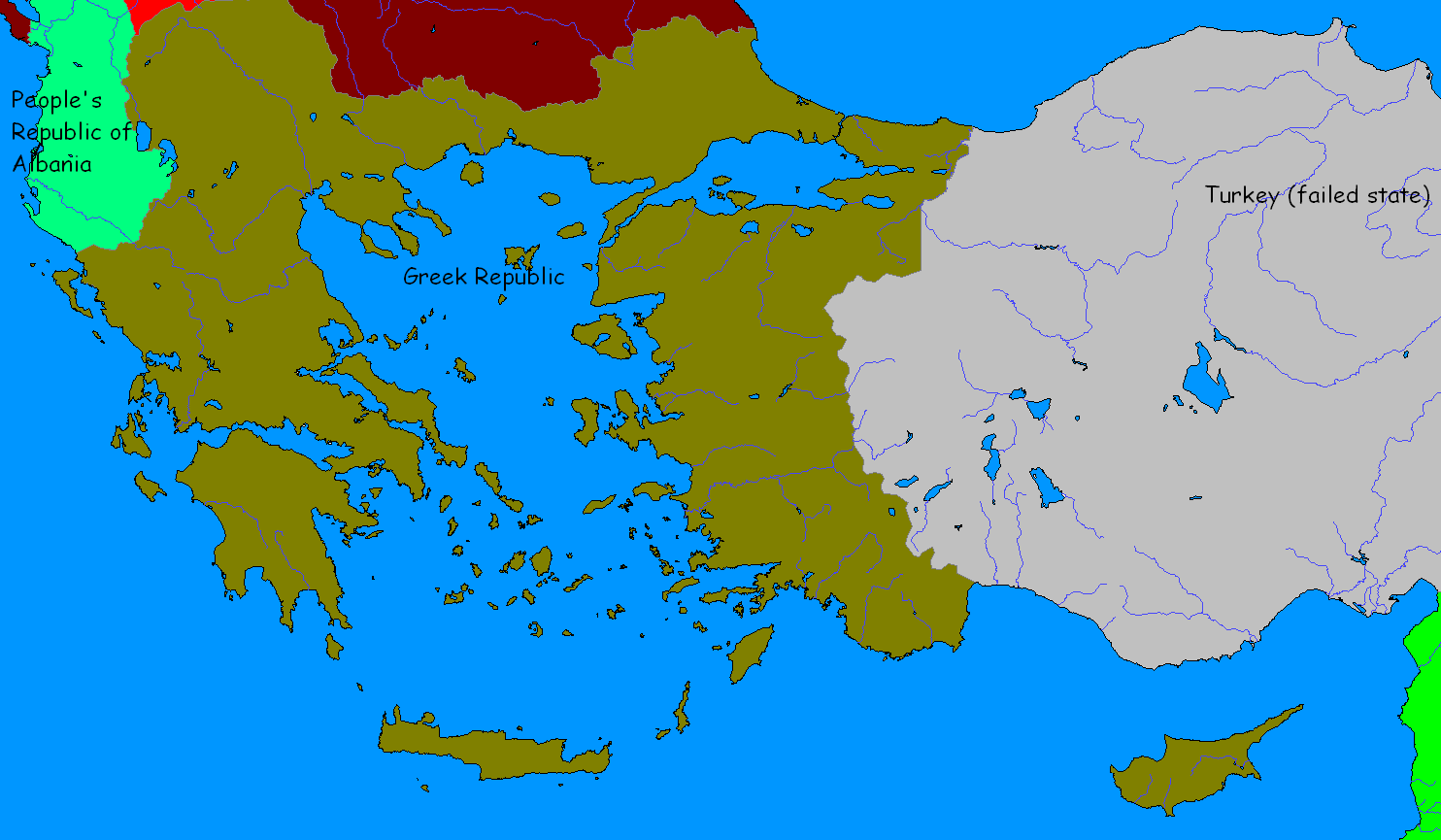
Almanac: Greece


Population: 62,317,040
Language: Greek
Religion: Greek Orthodox (Official)
Area: 377,800 km2
Capital: Constantinople
Largest Cities: Athens , Constantinople
Government: Republic
Head of State: Constantine Niarchos
Divisions: 23 States
Industries: Macedonia Tank Works, Tourism, Agriculture, Mining, Fishing
Crops: Wheat, Olives, Tobacco, Grapes, Almonds, Pomegranates
Resources: Building material, copper, fish
Currency: Drachma (7.23 = 1.00 US$)
GNP: $ 401 bin
Per Capita: $ 6,434.83
Import: Fuels, steel, electronics, software, chemicals
Export: Armored Fighting Vehicles, textiles, foodstuffs, marble, tobacco products, beer
Trade: Dutch Commonwealth, Kurdistan, Arab Republic, various African and Asian states.
Life Expec: 69.3 years
Education: Primary and Secondary are compulsory; state-paid Higher Education.
Literacy: 94.2%
Military: Standing Army of 200,000. Air force of 500 planes. Navy of 400 ships, mostly small.
Conscript: Yes; lottery system for ages 18-22; four year term of service.

Tuesday, September 7, 2010

Almanac: Java


Population: 52,984,132
Language: Dutch (official), Javanese
Religion: 90% Muslim, 4% Hindu, 3% Protestant, 3% Catholic
Area: 138,794 km2
Capital: Jakarta
Largest Cities: Jakarta
Government: Constitutional Monarchy
Head of State: Princess Beatrix
Divisions: 8 provinces
Industries: Petrochemical, spices, rubber
Crops: Coffee, sugar, cinnamon, ginger, rice, peanuts, sweet potatoes, cocoa
Resources: Oil, lumber, rubber
Currency: Guilder (0.603 = 1.000 $US)
GNP: $ 101 bin
Per Capita: $ 1,906.23
Import: Grains,
Export: Spices, petrochemicals, rubber, marble
Trade: Other Commonwealth Members, China, Japan, Australia
Life Expec: 69 years
Education: Primary and Secondary are compulsory; a 93% graduation rate
Literacy: 97%
Military: Part of the Dutch Commonwealth of Nations; home to 8th Fleet.
Conscript: No

Saturday, July 31, 2010

The Empire of Brazil


Almanac-Brazil

Population: 187,921,412
Language: Dutch (Official), Portuguese
Religion: 46% Catholic, 43% Protestant
Area: 8,734,447
Capital: Recife
Largest Cities: Recife, Fredericksbourg, Natal, Cayenne, Salvador
Government: Constitutional Monarchy
Head of State: Empress Beatrix
Divisions: Provinces, 29
Industries: Automotive, shipyards, aerospace, heavy industry, military hardware, mining, forestry, agriculture
Crops: Coffee, sugar, tobacco, cotton, tropical fruit, grains
Resources: Minerals, Gold, Precious Gems, Timber, Fish
Currency: Guilder (0.603 = 1.000 $US)
GNP: $ 5.181 tin
Per Capita: $ 27,570.03
Import: Clothing, electronic software, beef
Export: Steel, Iron, Copper, Metals in General, Lumber, Cotton, Coffee, Tobacco, Sugar, Automobiles, Industrial Equipment
Trade: Other Commonwealth Members, United States, Patagonia, Grand Colombia
Life Expec: 77.4 years
Education: Universal, compulsory primary and secondary school. 27% are privately owned.
Literacy: 98.2%
Military: Part of the Dutch Commonwealth of Nations. Home base for 2nd Fleet, 2nd and 3rd Air Forces, along with 14 divisions
Conscript: No

Tuesday, July 13, 2010

Capitals of the United States.

National: Philadelphia (1783-1800)
Washington (1800-1863)
Philadelphia (1863-1946)
Washington (1946- )

Confederate: Birmingham (1861-1941) (founded in 1861, designed as a national capital).


DE: Dover
PE: Allentown
CT: New Haven
GE: Atlanta
MA: Boston
NH: Manchester
MD: Annapolis
SC: Columbia
VI: Richmond
NC: Raleigh
RI: Providence
IQ: Oneida
KY: Knoxville
TN: Nashville
OH: Columbus
LO: New Orleans
IN: Fort Wayne
MS: Jackson
IL: Springfield
AL: Montgomery
ME: Portland
MR: Jefferson City
NA: New Amsterdam
AK: Little Rock
MI: Detroit
FL: Tallahassee
TX: Austin
IO: Des Moines
WI: Green Bay
CA: Vallejo
CU: Havana
SO: Sonora City
CH: Chihuahua
MN: Minneapolis
OR: Salem
KS: Topeka
DU: Port Sinoloa
NV: Carson City
NB: Omaha
CR: San Jose
CD: Boulder
LK: Aberdeen
MO: Helena
WA: Ellensburg
ID: Coeur d’Alene
WY: Cheyenne
UT: Ogden
LN: Lincoln
JE: Tuscan
CS: Vancouver
OK: Sequoia
AZ: Sante Fe

The Columbia Gorge Dam

Construction on the Gorge Dam began in 1937. Its goal was to create a lake to irrigate the entire Columbia Basin, and to generate electricity for the whole state of Washington. The dam was built only a kilometer upriver from Georgetown, where one of the many railroads cross the Columbia River. Today, Interstate 90 passes over the dam, and a man-made lake that, combined with the lake Grand Coulee Dam created, stretches all the way into Cascadia. There was some opposition to constructing the dam. The locals opposed it because it displaced them. Hundreds of square kilometers of orchards would be lost as well. The United States Army had limited opposition to it, since it would flood a number of Great War cemeteries that were scattered along the former American-Canadian border. The dam was completed in 1943, and power generated by it added to the war effort by 1944.

Monday, July 12, 2010

My State.


State of Washington

Statehood: November 11, 1889
Population: 6,520,124
Area: 184,827 km2
Capital: Ellensburg
Largest City: Seattle
Crops: Wheat, potatoes, fruit
Resources: Lumber, hydroelectricity
Industry: Software, electricity, aerospace

The state of Washington was carved from the northwestern sector of the portion of the Oregon Country that the United States acquired in 1849. The lands west of the Columbia River were lost in 1885 to Canada following the disastrous Third Anglo-American War. The remained of the state was admitted to the Union in 1889 with its capital at Ritzville. Washington served as a staging area just before the Great War for crossing the Columbia River and invading British territory. Following the Peace Treaty with the British, the lands between the Columbia River and the 49th Parallel were rewarded to the state. In 1919, the capital was moved to a more central location in Ellensburg.
During the 1930s, public works and private industry invaded the state. The Columbia and Snake Rivers were dammed, provided water supply for the Columbia Basin Project and electricity for the state and beyond. Boeing built two assembly plants in Seattle and Everett and its corporate offices moved to Seattle. Shipyards were opened at Bremerton and Everett, both served the war cause during World War II. Convair and North American followed suit, opening their own plants at Moses Lake and Lynnwood respectively.
During the 1980s, a second economic boom occurred with the rise of software companies. Microsoft, the largest software making in the world, is based in Redmond, Washington. Dozens of other software makers sprang up around Seattle during the Information Revolution. The third big industry in Washington is the production of electricity. The Gorge Dam and Grand Coulee Dam produce enough electricity to power most of the Pacific Northwest. Additional dams produce power that is exported as far away as Salt Lake City.
On the negative side, Washington has the second highest tax rate in the nation, behind California. Though it has no state income tax, property and sales taxes more than make up for it. This income is used to fund the infrastructure, education and various social programs. Washington has the highest standard of education in the United States, partially thanks to the efforts of the Gates Foundation.